

Solution



What is a Spatial Biomarker?
Interpreting spatial context transforms treatment.
“A next-generation biomarker that goes beyond expression levels to interpret spatial context.”

and integratively interprets where cells are located,
which cell types are present, and within what structural context
they exist.
Core Value
MEDICUS integrates spatial biology technologies with digital
pathology and AI,
transforming them into clinically interpretable indicators.
Through this, we establish new standards for precision diagnosis,
prognosis prediction, and drug discovery research.
Quantifying Spatial Context
Enabling objective analysis through the
quantification of spatial context.
Expanding the Standards of
Precision Medicine
Introducing a new paradigm for
precision diagnosis, prognosis prediction,
and drug discovery research.
Interpreting Complex Interactions
Integrating multidimensional information,
including intercellular distance, signaling
interactions, and tissue architecture.
Why Spatial Biomarkers?
The tumor microenvironment(TME) and spatial organization determine treatment response.
Cancer cells alone are insufficient to predict treatment response.
Interactions with surrounding immune cells and their spatial location are critical.


Core Value Proposition
Rather than simply measuring expression levels, spatial pattern
analysis dramatically improves the accuracy
of treatment strategy development.
Improved Prediction of
Treatment Response
Enhances the ability to identify responders to
immunotherapy compared to conventional
approaches.
Optimized Patient Stratification
Personalized treatment strategies based
on Hot vs. Cold Tumor pattern identification.
Minimizing Unnecessary Treatment
Reduces the use of ineffective high-cost
therapies, lowering patient burden.
Limitations of Conventional Approaches and a New Alternative
The Presence of “Spatial Context” Determines the Accuracy of Precision Medicine
IHC
ImmunohistochemistryTraditional
Limited detection of protein expression
Qualitative / Semi-quantitative (Scoring)
Subjective variability between observers
Limited analysis of cell-to-cell interactions
"Spatial information exists,
but is limited in accuracy."
Bulk RNA-Seq
Bulk RNA SequencingGenomic
Simultaneous analysis of thousands of genes
Highly quantitative data
Loss of spatial context
Provides an “average expression value” across the entire tissue
"Quantification is possible,
but spatial information is absent."
Spatial Transcriptomics AI
Spatial Transcriptomics AImedicus Solution
Spatial distribution of multiple genes and proteins
Continuous quantitative data with spatial coordinates
Algorithm-based, consistent quantification
Identification of cellular proximity and communication networks
"An integrated solution combining
spatial information, quantification,
and interaction analysis."
Through spatial transcriptomics validated across diverse human tissues,
the spatial distribution of cellular composition and gene expression can be precisely characterized.
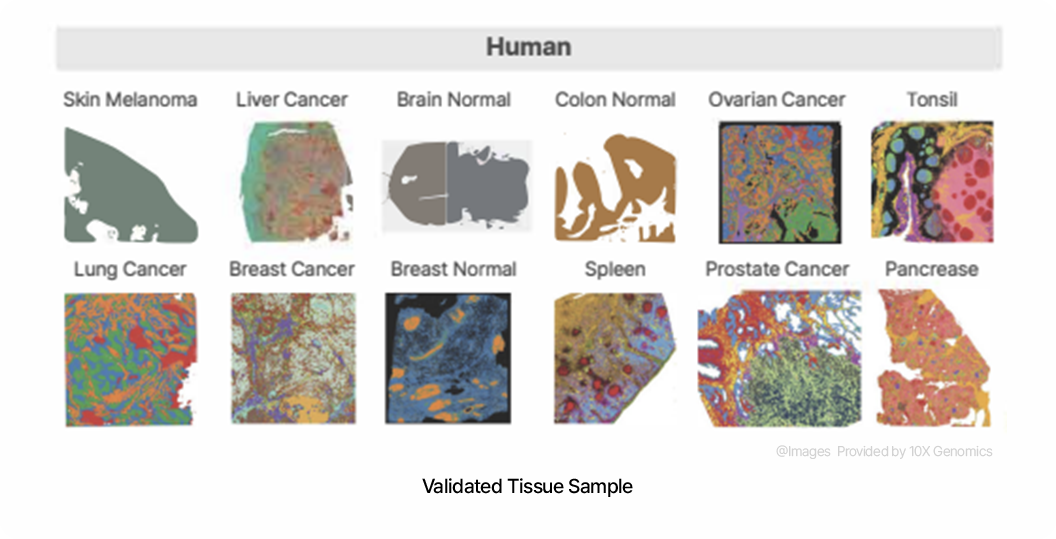
Spatial transcriptomics enables disease to be understood from a spatial perspective and
facilitates the discovery of novel spatial biomarkers.
MEDICUS Spatial Transcriptomics AI Solution
Core Tech Stack #1
 Data processing
10x Genomics Platform
By leveraging the Visium and Xenium platforms, morphological information (H&E) and gene expression profiles are fully integrated at single-cell resolution.
Visium HD
Xenium In Situ
 Boundary Analysis
ECM Boundary Reconstruction
Using proprietary algorithms, the complex tumor–stroma interface is precisely reconstructed, enabling identification of microenvironmental changes (such as ECM remodeling and EMT) and differentially expressed genes (DEGs) in those regions.
Tumor-Stroma Interface
DEG Identification
 Interaction Logic
SpaCET & SpaceMarkers
Advanced models calculate intercellular distances and interaction probabilities. In particular, spatial regulatory patterns between CAFs and TAMs are precisely characterized within the data domain.
*Spatial Cellular Estimator for TumorsColocalization
Cell-Cell Interaction
 Cloud Computing
MediAuto Processing
Gigabyte-scale whole slide images (WSIs) are processed in real time within a cloud environment,and instance segmentation accurately identifies and quantifies individual cells.
Real-time Processing
Instance Segmentation
Core Tech Stack #2
MEDICUS, as an integration of the Deconvolution, processes spatial transcriptomics analysis solutions.
Powered with 10x Genomics' most powerful spatial transcriptomics (ST) platform, that consistently evaluates targeted
gene expression patterns across tissues and MEDICUS customers need multi-modal analytical insights.
Approved Multimodal Platform
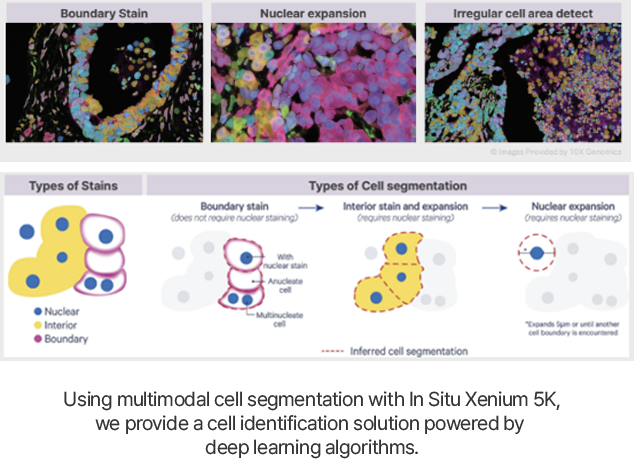
Data Analysis
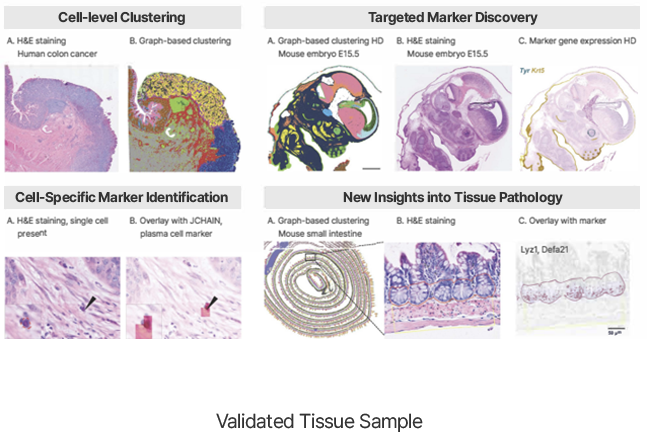
Core Tech Stack #3
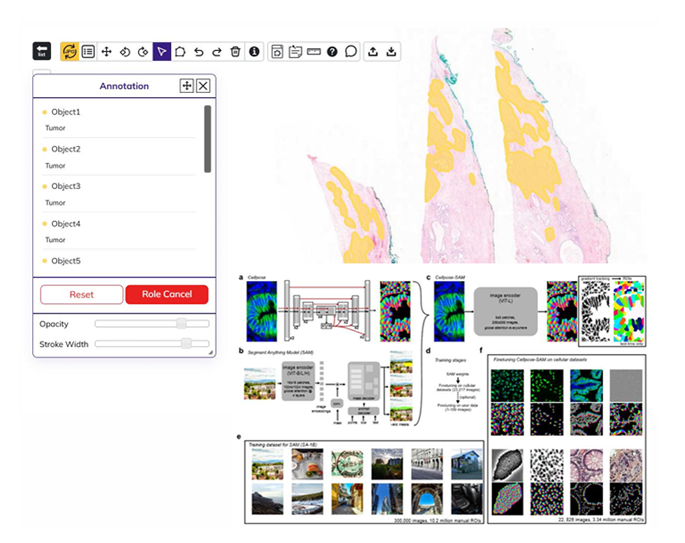
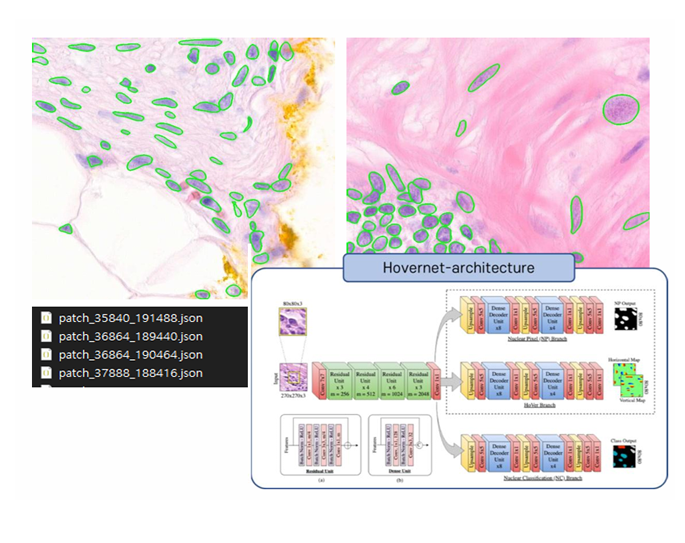
[medicus spatial digital biomarker analysis from data analysis to AI analysis]
Key Analytical Features

Tumor Microenvironment
(TME) Analysis
Quantification of key immune cell distributions and densities, including PD-L1, CAF, and M2 macrophages

Identification of Immune-
Excluded Regions
Detection of environments where T-cell infiltration is blocked through CAF–M2 interaction pattern analysis

CAF Subtype Classification &
Interaction Analysis
Visualization of myCAF/iCAF subtypes and their cellular interaction networks
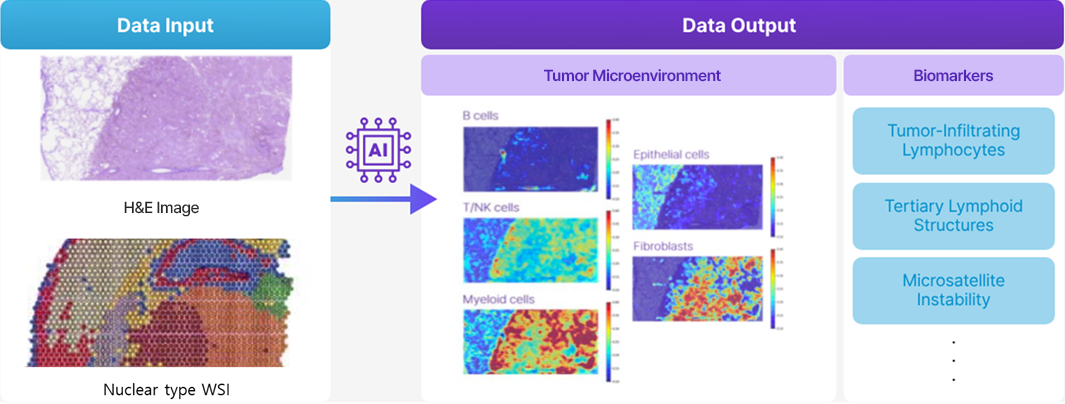
AI-Based Tumor Microenvironment Analysis and Biomarker Quantification Overview
Clinical Value
Establishing a New Standard for Data-Driven Precision Medicine

Maximizing Predictive
Accuracy
High-resolution spatial analysis
dramatically improves the
identification of immunotherapy
responders.

Standardizing Diagnosis
AI-driven algorithms eliminate
inter-observer variability and
establish objective, data-based
diagnostic criteria.

Minimizing Treatment
Failure
By identifying patients lacking an
effective immune microenvironment,
it prevents unnecessary treatments
and supports alternative therapeutic
strategies.

Scalability and
Accessibility
Through a cloud-based AIaaS model,
hospital-grade analysis is available
anywhere without the need for
expensive equipment.
Future Outlook: Expanding Spatial Multi-Omics
Building an Integrated Precision Medicine Ecosystem Beyond Single-Marker Analysis
Integration of Spatial Multi-Omics
Dual ISH-IHC Technology
Simultaneous analysis of proteins and RNA, integration of metabolomics data and implementation of a next-generation platform.
Discovery of Novel Biomarkers
CAF-LCN2 Axis
Identification of new targets driving immune resistance and characterization of resistance hotspots within tissues.
Expansion of Therapeutic Strategies
Combination Therapy
Proposing combination treatment strategies for drug-resistant patients(e.g., immunotherapy following radiation-induced modulation).
Completion of the Precision Medicine Ecosystem
Next Gen Pathology
Integrating single-cell research with digital pathology diagnostics to build a global treatment prediction platform.