

Solution



Digital Pathology Adoption, Yet Still Complex Workflows
Digital pathology has driven innovation in pathology,
but it has also introduced new structural challenges, including data fragmentation and operational complexity.
Limitations of Current Digital Pathology
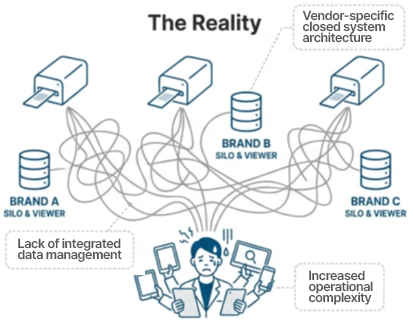
WSI fragmented across scanners and solution vendors
Increased operational burden on pathology and IT departments
Lack of a data foundation for AI and research utilization
The problem is not
digital
pathology itself, but
the lack
of a data
infrastructure.
Paradigm Shift
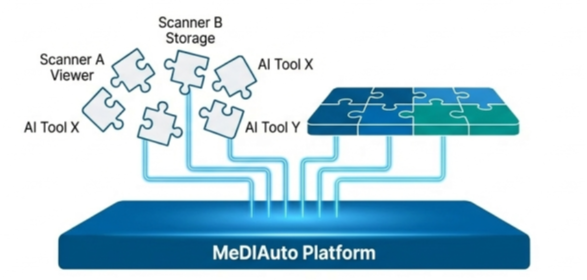
It is an AI-powered integrated pathology data
infrastructure that standardizes all WSIs and enables
seamless collection, management, analysis, and
integration.
Three Core Components of MeDIAuto

Unified
Management
WSI images generated from scanners by multiple vendors are centrally collected and managed on a single platform, eliminating data silos and maximizing operational efficiency.

AI-Ready
Data Environment
It provides a standardized data structure that is immediately usable for AI analysis, enabling seamless integration with new AI vendors without the need for additional development.

Hospital-Centric
Data Sovereignty
Built on on-premise hospital infrastructure, data is fundamentally protected from external leakage. This ensures an environment where hospitals directly control and own their data.
MeDIAuto Architecture: The Central Hub Connecting Systems
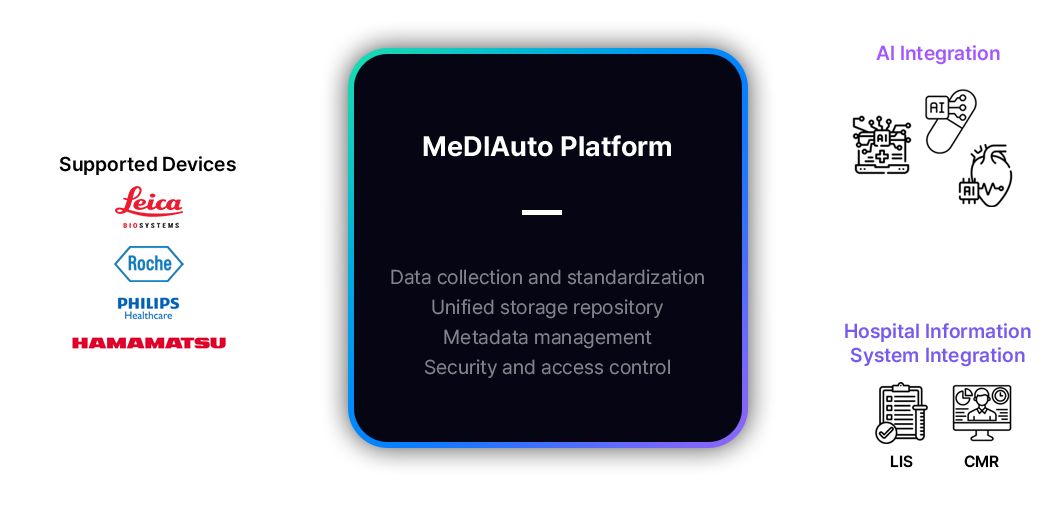
Through its open architecture, MeDIAuto flexibly connects everything from scanners to AI models and
hospital information systems (EMR, LIS), enabling stable and reliable management of the entire data lifecycle.
Platform Tour 1: A Unified View of All Operations – Dashboard
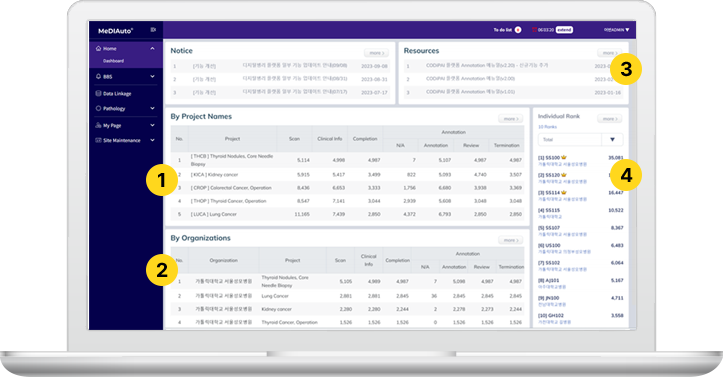
1
Real-Time Project Status
Tracks the number of collected cases, clinical data entry, and annotation status in real time
2
Data Status by User and Organization
Provides clear visibility into data collection and processing status by user and organization
3
Centralized Communication
All announcements, manuals, and critical information are centrally managed in one place, eliminating information gaps among users.
4
Operational Efficiency Monitoring
User-level statistics enable better resource allocation and improved operational efficiency.
Platform Tour 2: Case-Centric Integrated Data Management
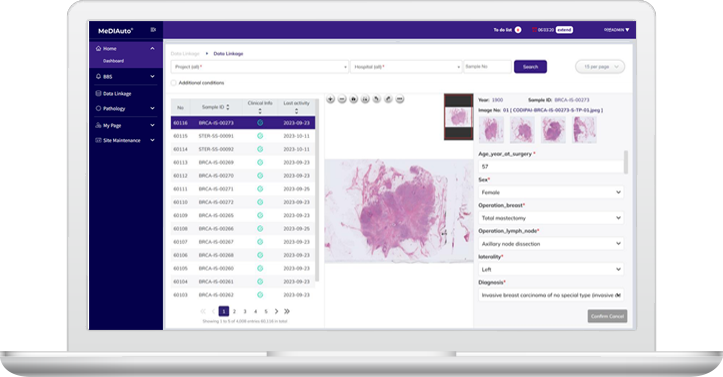
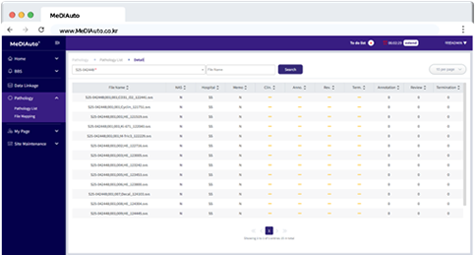
Integrated WSI Image Management
All WSI images are automatically collected regardless of scanner vendor and managed in a case-centric structure.
Image quality (QC) checks and status monitoring ensure data integrity.
Intelligent Metadata Integration
By integrating patient and examination information from HIS/LIS, images are automatically classified by pathology case, enabling the creation of structured and systematic datasets.
Advanced Search and Filtering
Advanced search and filtering by project, patient information, and diagnosis enable instant access to required pathology data within large-scale databases.
Platform Tour 3: An Innovative Environment Accelerating AI Analysis and Research

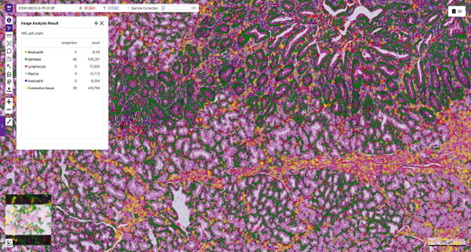

Web-Based Viewer and
Collaboration Tools
Review WSIs directly in the browser without additional installation, and generate data through precise annotation tools
Support real-time collaboration among medical professionals

Simultaneous Operation of
Multiple AI Models
Integrated linkage of diverse AI analysis results and systematic management of analysis histories
Provides a flexible environment that enables simultaneous operation of AI models for both clinical and research purposes

Research Data Utilization and Export
Supports research data requests and provides data in multiple formats including JSON, XML, and CSV.
MeDIAuto Use Cases: From Daily Operations to Future Research
1
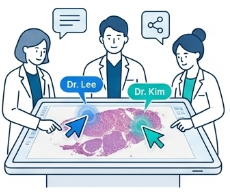
Enhancing Daily Pathology Operations
By standardizing the digital management of pathology slides, real-time collaboration among professors, residents, and pathologists is enhanced, while automated data search and classification reduce diagnostic turnaround time.
2
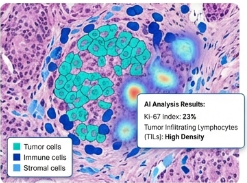
Clinical Application of
AI-Based Pathology Analysis
Advanced AI analyses—such as quantitative biomarker assessment and prognostic prediction models—are applied directly to clinical workflows, improving diagnostic accuracy and consistency.
3
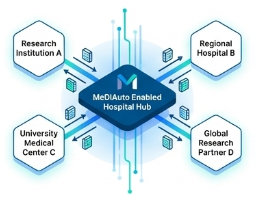
Accelerating Research and
Clinical Expansion
By establishing an integrated management foundation for multi-institutional research data, high-quality datasets for large-scale AI research projects can be rapidly built, strengthening overall research competitiveness.
Implementation Impact: Creating Value for All Stakeholders

From the Pathology Department
Perspective
Reduced turnaround time
(Automation of data search and classification)Improved data accessibility
(Secure access anytime, anywhere)Consistent diagnostic quality
(Standardized management and AI-assisted support)
From the Hospital IT
Department Perspective
Reduced system integration burden
(Unified management of multi-vendor scanners and hospital information systems)Improved maintenance efficiency
(Centralized management points)Simplified security management
(Integrated, on-premise–centered security)
From the Hospital Management
Perspective
Securing an AI-powered pathology
diagnostic foundation
Strengthening the image as a leading digital pathology hospital
Enhancing competitiveness in securing research projects
A Phased Expansion Strategy for Successful Implementation
Scanner Integration and Image Management
Integrate scanners from multiple vendors currently in use and establish a unified collection and basic management framework for WSI images.

Hospital System Integration and Unification
Seamlessly integrate data with existing systems such as EMR (Electronic Medical Records) and LIS (Laboratory Information Systems) to complete end-to-end clinical workflows.
AI Analysis Integration and Utilization Expansion
Integrate a wide range of commercial and research AI analysis models into the platform and establish a data analysis environment optimized for clinical application.
PoC and Pilot Operation Support
Before full-scale deployment, stability and effectiveness can be thoroughly validated based on real-world pathology workflows through PoC and pilot operations
The Unique Differentiators of MeDIAuto

Freedom from Scanner Vendor Lock-In
Without being locked into a specific scanner vendor, hospitals can freely choose their equipment, ensuring flexibility and long-term scalability.

AI Vendor–Agnostic Platform
As an open platform, MeDIAuto allows hospitals to freely select and integrate best-in-class AI solutions, enabling proactive adaptation to rapid technological advancements.

Hospital-Operation– Centric Design
MeDIAuto ensures hospital data sovereignty and is designed with top priority given to real-world workflows of pathology departments and hospital IT teams.

Simultaneous Support
for Research and
Clinical Use
It is a dual-purpose platform that enhances everyday clinical operations while simultaneously supporting advanced research and clinical trials..
